Зображення з Реєстру
Зображення з КАМІСу
Ідентифікатори
690-БВ МХ
· тип: Інвентарний облік (#2) · статус: Актуально (#1) · від: 2025-01-21
Унікальний ідентифікатор: 880202408281027
Зовнішнє ID: KM-4243
Назви
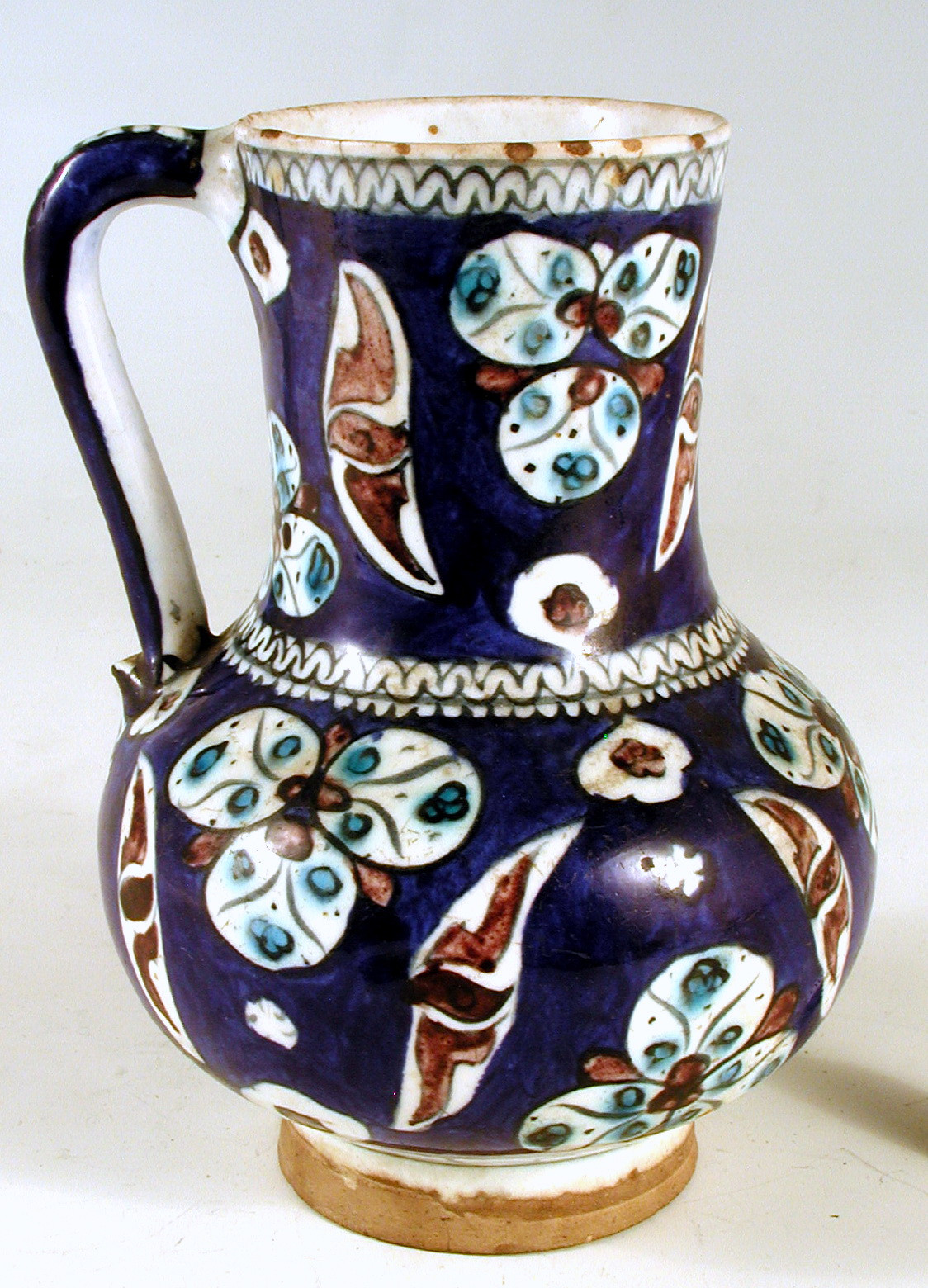
- Глечик з кулеподібним корпусом. [uk] · тип: Інвентарна (#5)
Класифікація
Матеріал і техніка
| Матеріал | Техніка |
|---|---|
| кашин (фаянс) #560 | Ангобування #114 |
| кашин (фаянс) #560 | підглазурний розпис #383 |
| білий барвник #614 | полива #381 |
| синій барвник (сполуки кобальту) #572 | Випал #115 |
Групи зберігання
Мистецтво Близ. СходуОписи
uk
Аналогіi: 1. An Iznik pottery jug. OTTOMAN TURKEY, CIRCA 1560-70.
http://www.christies.com/LotFinder/lot_details.aspx?pos=5&intObjectID=1821702&sid=
2. AN IZNIK POTTERY JUG. OTTOMAN TURKEY, CIRCA 1540 http://christiesinternational.com/LotFinder/lot_details.aspx?intObjectID=4791332
3. Iznik jug. c. 1575, decorated in cobalt blue, viridian and relief red with black outlines. H. 21 // Carswell... # 62, стор. 83
4. МХ №7 БВ/Історія Атрибуціi: 1. Collection Arthur Sambon. Catalogue des Objets D'Art. 1914. № 177, стор.44. Дамаск, 16 ст.
2.Вязьмітіна М.В. МКІ, 1930. Туреччина. Дамаск, 17 ст.
3. Міллер Ю.А. (Ермітаж), 1961. Туреччина, Дамаск, кін 16 ст. - поч. 17 ст.
4.
16 ст.
2./Кількість: 1/Побутування/творiв такого типу: Carswell: "Single-handled Iznik jugs, often with a torus moulding at the junction of neck and body, must also be imitating metal forms. These are quite common and often charmingly decorated with simple motifs, sprays of flowers and 'cintimani', groups of three crescents, and spiralling panels perhaps copying repousse prototypes".
"Damascus ware" Editar sección
The so-called "Damascus ware" was popular under Suleiman the Magnificent from 1540 to 1550. They use for the first time green and purple, in addition to cobalt blue and turquoise, and form a transition towards full-fledged polychrome ceramics.[4] There were again mistakenly labeled "Damascus" after some were found in Damascus, Syria, but were later understood to be derived from Iznik
cintimani: Carswell, стор. 83, 91. Міллер, 1972, стор. 58-59
The çintamani or triple leopard spot motifs in the far East symbolize the three holy attributes of Buddha, (Paquin, G.:Cintamani, Hali 64, August 1992, pp.104-119). In Ottoman Turkey it appears mainly on textiles but occasionally on Iznik and represents power, force and courage. Çintamani are sometimes seen grouped with pairs of wavy lines as can be seen in a similar shaped jug formerly in the Lagonikos Collection, Alexandria, (Carswell, J. Iznik Pottery, London, p.83, fig.62). The three circles however appear more often on their own as in this fine example, although it is more unusual to find them contained within pomegranate-shaped panels. The same combination, but on a fish-scale ground, is found on a jug in the Gulbenkian Collection (Ribeiro, Maria Querios: Iznik Pottery, Lisbon, 1996, no.70, p.215). The same collection has a slightly earlier dish with a wonderfully strong version of exactly this combination of pomegranate panels alternating with çintamani on a blue ground (Ribeiro: op.cit, no.16, p.123).
Про чинтамані у Міллера - стор. 58-59 (Худ.кер.Турции, 1972)
uk
Розміри: В – 23; Дв – 8; Дд – 8
uk
Документи переміщення - Дата документа: 2021-12-25 00:00:00/NAMEDOC: Акт про приймання предметів на МВЗ/Дополнение: експонування в постійній експозиції музею/Дополнение: Корпачова Л.Т./Дополнение: Крамарева О.А.
uk
Сдатчик-частное лицо: колекція Б.І. та В.Н. Ханенків.
uk
Закладка “Атрибуція” - Наим. предмета, издания: Глечик/Змiн. час створення: кін. XVI - поч. XVII ст.місце створення, школа: ТуреччинаНовый материал: кашин (фаянс)Новый материал: білий барвникНовый материал: синій барвник (сполуки кобальту)Новый материал: бірюзовий барвник (сполуки міді)Новый материал: бордовий/коричневий барвник (сполуки марганцю)Новый материал: чорний барвникПериод: доба Османської ІмперіїИзм. техника: ангобуванняИзм. техника: підглазурний розписИзм. техника: поливаИзм. техника: випал
uk
На шийці тріщина. В окремих місцях надщерблення.,
Персоналії
Колекції
Характеристики
Стан
Розміри
Ціни
Події
| Тип | Місце (uk) | Місце (lat.) | Місце (other) | Дата (text) | Роки | Джерело | Коментар |
|---|---|---|---|---|---|---|---|
| Створення (#1) | Туреччина | XVI-XVII ст.ст. | — | — | — |
Gemstones
Дорогоцінні метали
Базові значення
- state: 1 (?? Статус предмета = На постійному зберіганні (#1) ??)
- Службова інформація - підпис (status): Чернетка (#1)
- Класифікація (classification_id): — #—
- Можливість транспортування (is_transportable): 0
- Держреєстр національного культурного надбання (is_registered): 0
- Топографічний шифр (topography_code): вітрина
- Спосіб надходження (acquisition_method): (#)
- Джерело надходження (acquisition_source): з зібрання Б. І. та В. Н. Ханенків
- external_id: KM-4243
- creator_id: 165
- updater_id: 165
- owner_id: 90
- keeper_id: 90
- is_fragment: 0 (?? Фрагмент = 0 ??)
- is_private_images: 0
- storage_location_id: —
- introduction_reason: —
- delete_reason: —