Зображення з Реєстру
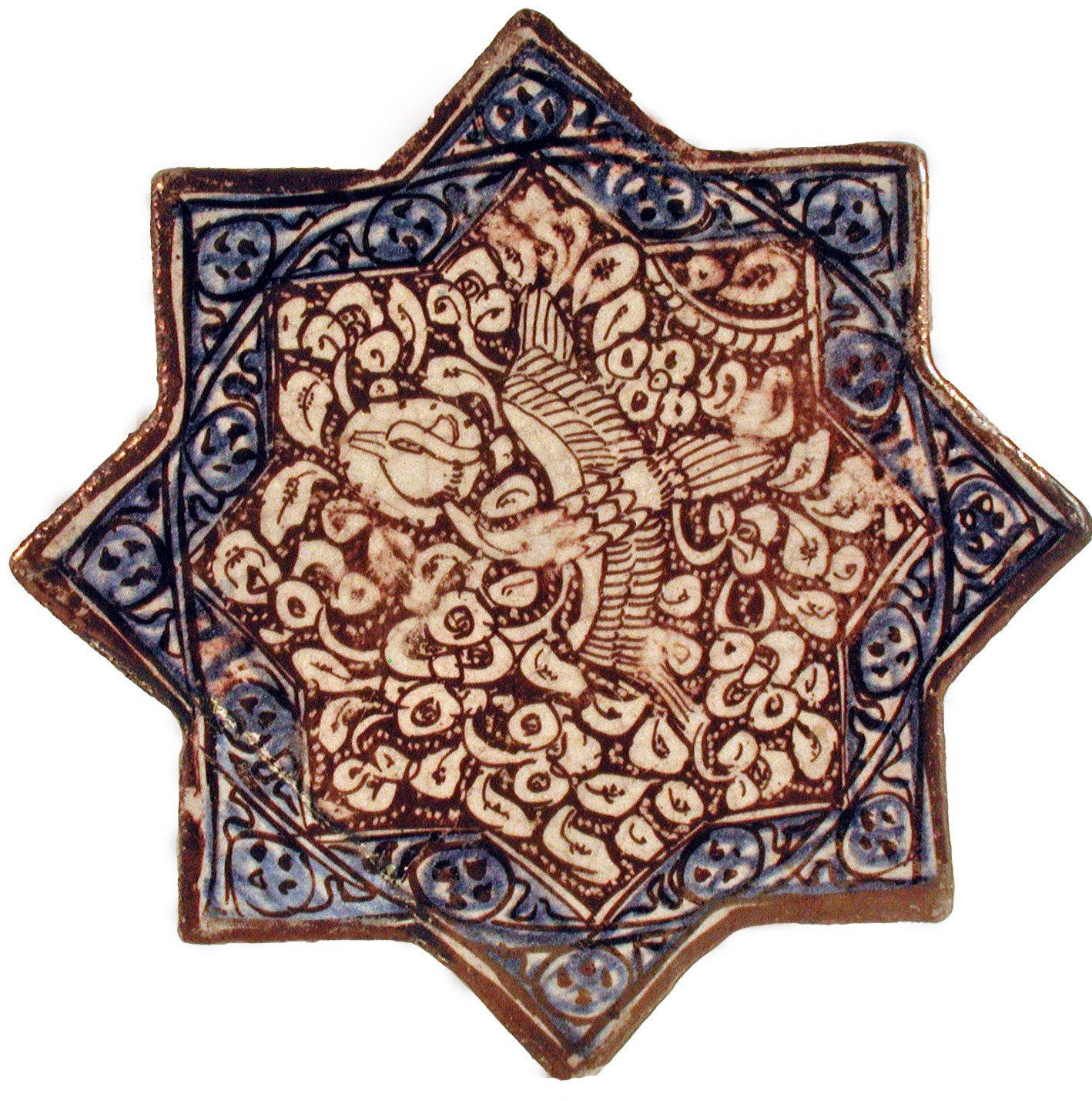
Зображення з КАМІСу
Ідентифікатори
36-БВ МХ
· тип: Інвентарний облік (#2) · статус: Актуально (#1) · від: 2025-01-21
Унікальний ідентифікатор: 368202408281399
Зовнішнє ID: KM-4615
Назви
- Кахель у вигляді восьмикутної зірки. [uk] · тип: Інвентарна (#5)
Класифікація
Матеріал і техніка
| Матеріал | Техніка |
|---|---|
| Фаянс #56 | розпис синім #395 |
| Фаянс #56 | розпис люстром #404 |
Групи зберігання
Мистецтво Близ. СходуОписи
uk
Аналогіi:
1. Форма кахля, центральний мотив/ трактування, мотив тла, розробка тла: The Victoria and Albert Museum:
http://collections.vam.ac.uk/item/O120597/tile/
Tile with Phoenix and Qur'anic text. Iran. 1275-1325. Moulded fritware tile in the shape of an eight-pointed star, with a depiction of a phoenix in flight surrounded by a quotation from the Qur'an. Colour in the glaze and lustre over the glaze. D – 20,5, H – 1,8, Weight 0,6 kg. Acc.# 1025-1892
Повністю аналогічні кахлі в The British Museum:
http://www.britishmuseum.org/research/search_the_collection_database/search_object_details.aspx?objectid=235653&partid=1
2. Форма, стиль розпису, композиція, мотиви тла, розробка тла, мотив бордюру: The British Museum:
Tile(s). Iran, Kashan. Late 13th century. Stonepaste, opaque white glaze; underglaze cobalt blue borders, overglaze brown-pink lustre design. D- 12,6. Reg.#G.221
http://www.britishmuseum.org/research/search_the_collection_database/search_object_details.aspx?objectid=215404&partid=1&output=Terms%2F!!%2FOR%2F!!%2F16577%2F!%2F%2F!%2Fmusician%2F!%2F%2F!!%2F%2F!!!%2F&orig=%2Fresearch%2Fsearch_the_collection_database%2Fadvanced_search.aspx¤tPage=17&numpages=10
3. Мотив бордюру, рослини, загальна композиція кахля, люстр: Victoria and Albert Museum:
Tile. Kashan, Iran. Early 14th century. Fritware, glazed and painted in cobalt blue and lustre. 1493F-1876
http://collections.vam.ac.uk/item/O202846/tile/?print=1
4. Форма, стиль розпису, композиція, мотиви тла, мотив бордюру: Державний Ермітаж:
Кахель. Іран, 2 пол. 13 ст. Фаянс, люстр, кобальт. Діам. 21 см. ИР-1275.// От Китая до Европы. Искусство исламского мира. Каталог выставки. Стор.131
5. Розробка тла – датований зразок: Museum of Fine Arts, Boston:
Star tile with horse. Persian, Ilkhanid (Mongol), dated 710 H., equivalent to A.D. 1310.
Probably Kashan; so-called Sultanabad style, Iran. D- 19.6 cm. Composite body (quartz, clay, and glass frit), underglaze painted in cobalt blue and overglaze painted in luster. Accession Number 31.729
http://www.mfa.org/collections/object/star-tile-with-horse-17756
/Історія Атрибуціi: 1. Крачковская В. 1926. Персия, Султанабад, 14 ст.
2. Вязьмітіна М. 1930. Іран, Султанабад, 14 ст.
3. Гюзальян Л.Т., 1953. Іран, 2 пол. 13 ст.
4. Рудик Г.Б. 2012. Іран, ймовірно, Кашан. Кінець 13 – початок 14 ст.
/Кількість: 1/Історія предмета, легенда: Whereas Chinese motifs are secondary on these overglaze-painted wares, contemporary luster-painted wares exhibit a striking Far Eastern iconography, both floral and figural. Lotus and peony blossoms, dragons and phoenixes (Plate xxix), cloud bands, composite horned creatures with cloven hooves (ch’i-lins; sometimes written qui’lin), and Chinese lions became stock decorative elements, and human figures were rendered in a mannered way, with elongated torsos and squarish facial features, rather than the pudgy, full-moon faces of the earlier period. Of course, details of dress, especially headgear, were changed as well. The general painting style is broader, the individual elements larger and less delicate, and the luster a deeper red or purple, rather than the brownish tones of earlier wares. Whereas cobalt-blue glaze had occasionally been added to luster pieces in the preceding period, under the Il-khanids cobalt blue became a dominant “second color” on luster wares. A considerable number of dated pieces extending from the mid-7th/13th to the 8th/14th century illustrate the evolution of the Il-khanid luster-painting style (see, e.g., Survey of Persian Art, pls. 714-15, 773-75).
Про високу ймовірність кашанського походження монгольських люстрів див: Mason, Robert. Shine Like the Sun: Lustre-Painted and Associated Pottery from the Medieval Middle East. Biblioteca Iranica:Islamic Art and Architecture Series. 2004. Стор.179. Також: Oliver Watson. Ceramics from Islamic Lands. Thames and Hudson, 2004. Стор.363.
Розробка тла дрібними крапками свідчить про належність кахля до описаних Р. Мейсоном груп люстрованих виробів Ірану №№9 (1285-1310) та 10 (1310-1340). У трактовці центрального мотиву птаха відчувається вплив китайського мистецтва доби Юань (голова а-ля фенікс), активні взаємовпливи якого з мистецтвом Ірану припадають на період з останньої третини 13 ст. Це дає підстави уточнити датування: кінець 13 –початок 14 ст. Аналогії підтримують таке датування
фаянс (stonepaste body). Mason, Robert. Shine Like the Sun: Lustre-Painted and Associated Pottery from the Medieval Middle East. Biblioteca Iranica:Islamic Art and Architecture Series. 2004. Стор. 133-134.
Публікація в статті: Крачковская В. A. Мусульманское искусство в собрании Ханенко. Записки коллегии востоковедов, ІІ, 1926.
/Побутування/творiв такого типу: За формою кахель продовжує традицію восьмикутних зірок, що в облицювальному пано чергувалися з хрестами.
Декор кахля виказує художні вплив юанського Китаю, що загалом характерно для іранської кераміки епохи ільханів ( 1256-сер.14ст.). Центральну фігуру птаха (Симурга) трак
uk
Розміри: 21 х 21
uk
Документи переміщення - Дата документа: 2021-12-25 00:00:00/NAMEDOC: Акт про приймання предметів на МВЗ/Дополнение: експонування в постійній експозиції музею/Дополнение: Корпачова Л.Т./Дополнение: Крамарева О.А.
uk
Сдатчик-частное лицо: колекція Б.І. та В.Н. Ханенків.
uk
Изображённые лица: Симург
uk
Закладка “Атрибуція” - Наим. предмета, издания: Кахель у формі восьмикутної зірки, люстрований із зображенням птаха/Змiн.опис: Кахель у формі восьмикутної зірки розписано синім тоном на сирій поливі кремового кольору та червоно-коричневим люстром надглазурно. В центрі зірки зображено восьмикутний медальйон, вписаний в коло. Центральну композицію виконано в люстрі резервом: фантастичний птах летить справа наліво на тлі густого стилізованого рослинного орнаменту (листя та пальмети). Голову птаха оточено ореолом. В правому верхньому куті медальйона зображено пташеня в гнізді (?). Тло розпису гравіровано лініями дрібних крапок. Медальйон облямовують 2 ряди утворених колом умовно-трикутних полей, в які вміщено овали із дрібними завитками та кільцями, написані люстром по синьому тлі. Край кахля окреслено подвійною люстровою смугою./Змiн. час створення: Доуга половина 13 ст.місце створення, школа: КашанПериод: доба ІльханідівНовый материал: фаянсИзм. техника: розпис синімИзм. техника: розпис люстромИзм. техника: біла полива
uk
Задовільний.,
Персоналії
Колекції
Характеристики
Стан
Розміри
Ціни
Події
| Тип | Місце (uk) | Місце (lat.) | Місце (other) | Дата (text) | Роки | Джерело | Коментар |
|---|---|---|---|---|---|---|---|
| Створення (#1) | Іран | — | — | — | — |
Gemstones
Дорогоцінні метали
Базові значення
- state: 1 (?? Статус предмета = На постійному зберіганні (#1) ??)
- Службова інформація - підпис (status): Чернетка (#1)
- Класифікація (classification_id): — #—
- Можливість транспортування (is_transportable): 0
- Держреєстр національного культурного надбання (is_registered): 0
- Топографічний шифр (topography_code): вітрина
- Спосіб надходження (acquisition_method): (#)
- Джерело надходження (acquisition_source): з зібрання Б. І. та В. Н. Ханенків
- external_id: KM-4615
- creator_id: 165
- updater_id: 165
- owner_id: 90
- keeper_id: 90
- is_fragment: 0 (?? Фрагмент = 0 ??)
- is_private_images: 0
- storage_location_id: —
- introduction_reason: —
- delete_reason: —