Зображення з Реєстру
Зображення з КАМІСу
Ідентифікатори
700-БВ МХ
· тип: Інвентарний облік (#2) · статус: Актуально (#1) · від: 2025-01-21
2226
· тип: Інвентарний облік (#2) · статус: Неактуально (#2) · від: 2025-01-21
1136-ПН
· тип: Первинна реєстрація ОФ (#1) · статус: Актуально (#1) · від: 2025-01-21
Унікальний ідентифікатор: 713202408281038
Зовнішнє ID: KM-4254
Назви
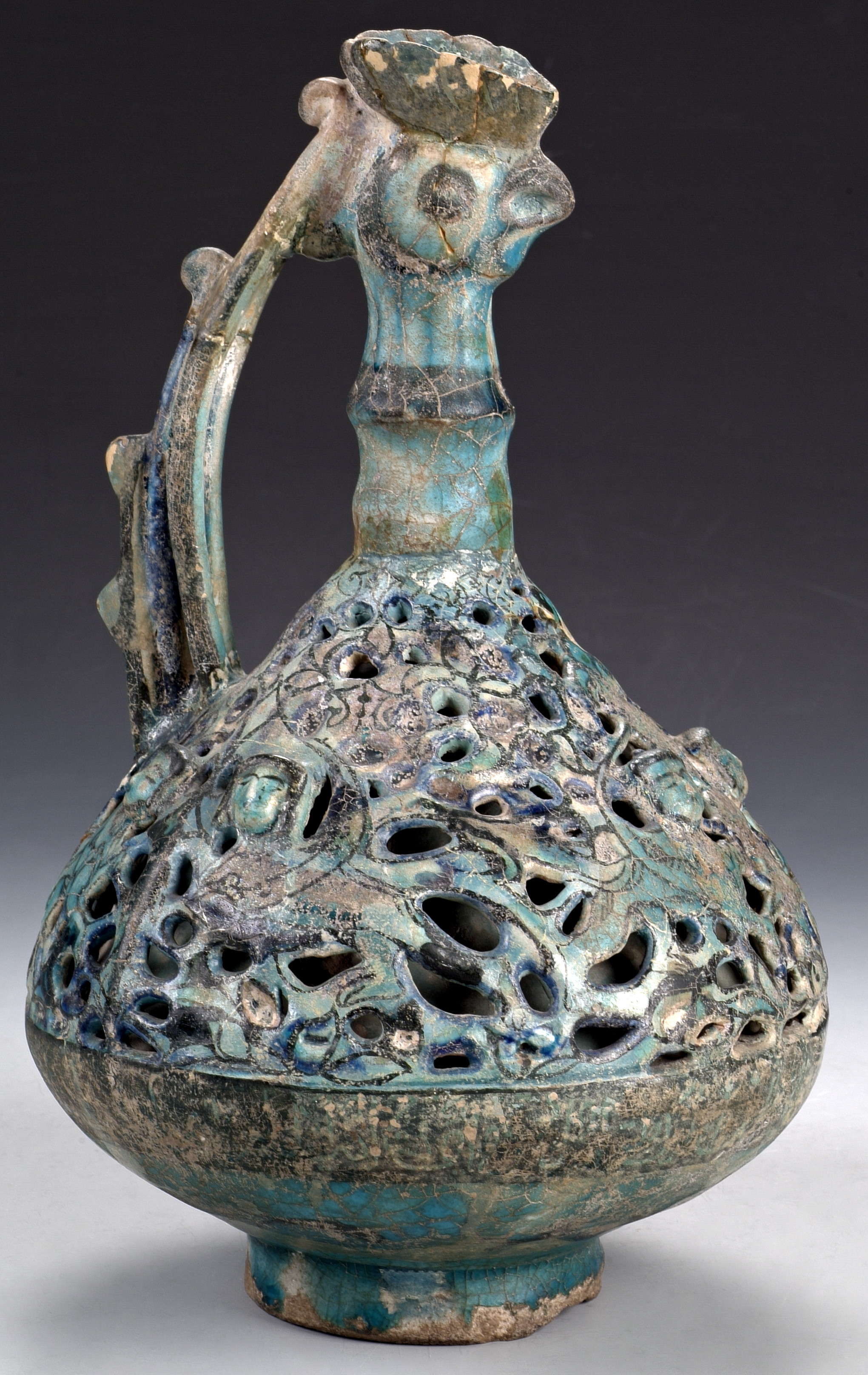
- Глек з корпусом грушоподібної форми з подвійними стінками (верхні - ажурні) [uk] · тип: Інвентарна (#5)
Класифікація
Матеріал і техніка
| Матеріал | Техніка |
|---|---|
| Фаянс #56 | рельєф #386 |
| Фаянс #56 | Перфорація #248 |
Групи зберігання
Мистецтво Близ. СходуОписи
uk
Комм.: Тонка зовнішня ажурна стінка глека утворює складний декор з трьох пар крилатих сфінксів серед рослинних мотивів. Образ півня був пов'язаний в свідомості середньовічних іранців з давньоперським міфічним птахом Симургом і, аналогічно, мав значення оберега ( в даному випадку - захищав власника глека від отруєння). Риби, зображені на нижній частині глека також мали благозичливе значення.
An odd piece
Curiously, the form of this pitcher evokes the shape of a rooster. The pear-shaped body and the handle represent the body and the tail. The pouring-spout is in the shape of a rooster's head with its crest, beak, and large, round eyes.
Under the Tang Dynasty (618-907), ewers in the shape of a phoenix were produced. In Iran, this form was fairly widespread in the 13th and 14th centuries.
Just as curiously, the side of the piece is reticulated, an evidently impractical idea for a vessel designed to contain liquids. In fact, the pierced wall hides a second, interior wall that is smooth. This is made clear by slight bulges at the base of the neck and at the level of the verse extolling the glories of wine, in accordance with what the object was used for.
A small pot in the Metropolitan Museum in New York, also reticulated and dated to 1215, helps us place the origins of this type of decoration in the early 13th century.
Openwork metal objects were fairly frequent around the same period. These were often lamps, but also served as incense burners. The animal shapes of these objects - such as a lion (AA 19) or a falcon (OA 4044 bis) - make them close relations of this ewer.
The Wak-Wak tree
A second, superimposed decoration is painted with a black line beneath the turquoise glaze. Among the leaves of a tree, human and animal heads - and even entire creatures - sprout like fruit from the branches.
This ornamentation refers to the legend of the Wak-Waks, which was probably brought back by Islamic sailors. The story's first recorded appearance, between 766 and 801, was the work of a Chinese man who heard it from his cousin, who was a prisoner of the Muslims for twelve years. Islamic cosmographers, zoologists, and other scholars embellished this theme in works they wrote upon returning from their travels. All agreed on one thing: when the fruits of this tree were ripe, they fell to the ground crying "wak-wak." According to some, the fruits were women or small children; others held them to be intermediate forms "between the plant and animal kingdoms." In his 13th century work, Marvels of Things Created and Miraculous Aspects of Things Existing, al-Qazwini described - in addition to such creatures as the Beast of Judgement, with its giraffe's body, human head, and horns of a deer - the island of the Wak-Waks and their odd fruit trees.
Alexander and the tree with talking leaves
The theme is close to that of the tree with the gift of speech that Iskandar - known to us as Alexander - met during his travels in India, according to the account of his voyage by Pseudo-Callisthenes, king of Persia. An episode in the Shahnameh (The Epic of Kings) recounts that this tree only spoke when night fell and that it could tell the future. When questioned by Iskandar, the tree predicted that he would never see his mother or his homeland again. This ill omen was perfectly true: Alexander died shortly thereafter./Аналогіi: Назагал у світі відомий не менш як 21 предмет, виконаний в цій техніці. (E.J.Grube. Cobalt and Lustre. Стор. 151)
1. Повна: Linden-Museum Stuttgart. Глек з подвійною стінкою з горлом у формі голови півня. Кашан. Іран, початок 13 ст.
2. Повна: Detroit Museum of Art. Глек з подвійною стінкою у формі півня. Іран, династія Сельджуків. About 1200. Under-glaze slip-painted fritware. Dimensions 10 3/4 x 6 3/4 x 6 in. ( 27.31 x 17.15 x 15.24 cm) Accession No. 1989.34 http://www.dia.org/object-info/4b21978a-3798-459c-a58b-9d90d3130202.aspx?position=6
3.Повна: V&A Museum. Ewer Iran, Kashan; found at Jurjan. Early 13th c. CE. Fritware painted under a coloured glaze. H.: 29.1 cm.; W.: 16.1 cm.
http://collections.vam.ac.uk/item/O88418/ewer/
4. Повна: Louvre Museum. Ewer with rooster head. Early 13th century. Iran, Kashan. Fritware with reticulated, engraved, and painted decoration under a transparent colored glaze. H. 40 cm; Diam. (max.) 65 cm. Gift of the Friends of the Louvre, 1970. MAO 442
5. Дуже близька: Freer Gallery of Art. http://www.asia.si.edu/collections/zoomObject.cfm?ObjectId=10575. Double-shelled ewer. early 13th century. Saljuq period. Stone-paste body painted under glaze. H: 29.1 W: 18.1 D: 18.1 cm. Iran. F1949.19
/Історія Атрибуціi: 1.Riviere, Henri. La ceramique dans l'art musulman. 1913
2. Collection Arthur Sambon. Catalogue des Objets D'Art. 1914. Персія (Рей) 13 ст.
Лінко Л. Перська кераміка XIII віку в музеї мистецтв ВУАН. // Відбиток зі збірника "Український музей", вип.І, видання Укрнауки У.С.Р.Р. 1927. 1927. Персія, 13 ст.
3. Вязьмітіна М. «МКІ», 1930. Іран, Рей (Султанабад) 13 ст.
4. Г
uk
Розміри: 26х7,5х2,5/Розміри (англ.): 26х7,5х2,5/Розміри (русск.): 26х7,5х2,5
uk
Документи переміщення - Дата документа: 2021-12-25 00:00:00/NAMEDOC: Акт про приймання предметів на МВЗ/Дополнение: експонування в постійній експозиції музею/Дополнение: Корпачова Л.Т./Дополнение: Крамарева О.А.
uk
Сдатчик-частное лицо: колекція Б.І. та В.Н. Ханенків.
uk
Закладка “Атрибуція” - Наим. предмета, издания: Глек з подвійною стінкою у формі півня/Змiн. розміри: 27,5х8/Змiн.додаток до назва (лист, ...): Глек с подвійною стінкою та горлом у формі півня/Змiн.опис: Глек на кільцевій ніжці має тулово грушовидної форми з подвійною стінкою - суцільною внутрішньою (резервуар для рідини) та ажурною зовнішньою (суто декоративною). Тулово переходить у вузьку циліндричну шийку та горло, модельоване у формі голови півня. Гребінь півня формує овальний отвір для зливу. Ручку глека модельовано у формі півнячого хвоста. Ажурний декор зовнішньої поверхні складається з трьох пар крилатих сфінксів у геральдичній композиції, оточених листяним орнаментом. Чорним тоном виділено контури рельєфних мотивів, в нижній частині тулова чорним нанесено зображення риб, також чорним прописано дзьоб, очі та гребінь. Глек повністю вкрито бірюзовою поливою. Окремі елементи декору підкреслено синім по сирій поливі./Змiн. час створення: 13 ст.місце створення, школа: КашанИзм. техника: рельєфИзм. техника: перфораціяИзм. техника: розпис синімИзм. техника: розпис чорнимНовый материал: фаянсИзм. техника: прозора полива
uk
Наліт іризації. У верхній частині ручки поперечна тріщина. Склеєний.,
Персоналії
Колекції
Характеристики
Стан
Розміри
Ціни
Події
| Тип | Місце (uk) | Місце (lat.) | Місце (other) | Дата (text) | Роки | Джерело | Коментар |
|---|---|---|---|---|---|---|---|
| Створення (#1) | Персія,Рей per | XIII ст. | — | — | — |
Gemstones
Дорогоцінні метали
Базові значення
- state: 1 (?? Статус предмета = На постійному зберіганні (#1) ??)
- Службова інформація - підпис (status): Чернетка (#1)
- Класифікація (classification_id): — #—
- Можливість транспортування (is_transportable): 0
- Держреєстр національного культурного надбання (is_registered): 0
- Топографічний шифр (topography_code): вітрина
- Спосіб надходження (acquisition_method): (#)
- Джерело надходження (acquisition_source): з зібрання Б. І. та В. Н. Ханенків
- external_id: KM-4254
- creator_id: 165
- updater_id: 165
- owner_id: 90
- keeper_id: 90
- is_fragment: 0 (?? Фрагмент = 0 ??)
- is_private_images: 0
- storage_location_id: —
- introduction_reason: —
- delete_reason: —